
Michael and Ripley, and the long road to running together
I Got a Dog Who Can Run, So Naturally I Wrote Her a Training Manual
I have had dogs before. I have two right now, a long-haired miniature dachshund named Guinness, who is seventeen years old and whose idea of an endurance event is the walk from the couch to the food bowl. I also have Solo, a very traumatized rescue we got on the streets of Mexico City. His idea of exercise is barking loudly at all the other dogs on the trail. He is scared and needs extra love. I love them both. They are good and quirky boys. But they are unlikely to run with me, and we all know it.
Ripley is different.
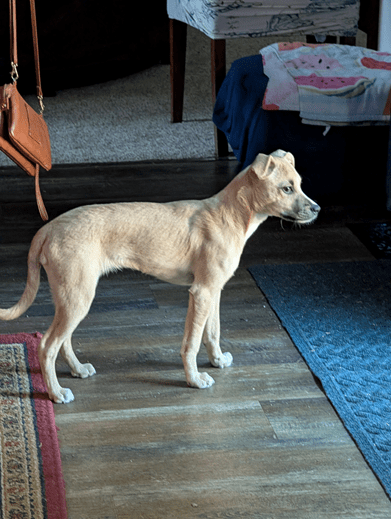
She is a mixed breed, all legs and energy, and the first time I watched her move across the yard I had the thought every runner who owns a dog eventually has: oh. Oh, she could come with me. Not now, she is a baby. But someday, on the easy miles, on the kind of morning that is better with company. A running partner. The real thing.
And here is where I should probably warn you about how my brain works.
When something new grabs me, I do not dabble. I go down the hole. My ADHD does not ask polite questions, it asks every question, all at once, at two in the morning, and then it wants citations. So a simple thought, “maybe Ripley could run with me,” turned into three weeks of reading about growth plates and breed builds and bloat and how dogs actually cool themselves, which it turns out is not the way I assumed. Somewhere in there the questions piled up high enough that I did the only reasonable thing. I wrote it all down.
What came out the other side is a real training guide. When to start, and more importantly when not to. How a dog’s body grows and why you can wreck it by rushing. How to read a dog who will never once tell you she is hurting, because dogs hide it to keep up with us, and the watching is entirely on us. What the weather does to them. When to feed. How far is too far. I tried to be honest about which parts are backed by veterinarians and research and which parts are just me, a guy who runs stupid distances, making a reasonable call.
I built it around Ripley. But almost none of it is really about Ripley. If you run, or want to, and you have a dog who looks at you like they want in, most of this is for you too. You would swap her numbers for your dog’s and ask your own vet to fill in the blanks, and the rest holds.
So that is what this is. One runner’s obsessive rabbit hole, cleaned up and made useful, because I figured if I was going to learn all of it anyway, someone else might as well skip the two in the morning part.
Here is the guide.
| Runner | Michael. I run the Galloway method, run-walk-run, about 12:30 a mile. Yes, I walk on purpose. It works. |
| Partner | Ripley. She is a Mixed breed, born January 18, 2026. Currently 80 percent legs. |
| Build | Long fine limbs, deep chest, clear waist tuck, straight topline. |
| Lifetime target | Somewhere around 10 to 13 miles as her comfortable distance once grown, depending on how she matures. That is the ceiling, and it is a good one. |
About the team
I am Michael. Misha to some of you. Two marathons done, and this coming weekend I line up for my first 24-hour race, which is a long way of saying I am about to find out what I am made of past mile 26. I do not run for the numbers on my watch. I run for my head and for the way it feels to be out there. That matters here more than it sounds, because it is the same reason I am the right person to bring a dog along slowly instead of chasing splits with her.
Here is the thing the whole guide is built on. You cannot rush it. The patience is not a trick I do at the edges. It is the point. I learned it the long way, in training, in the dark, in the miles that do not show up on any results page.
Ripley does not know any of that. She is a young dog made of legs and energy and the firm belief that everything on the ground is a snack. The plan is to turn her into a running partner the same way I build toward a long race. Slowly. On purpose. Without skipping the boring early work, because the boring early work is what makes the late miles possible.
The Galloway method helps more than you would think. The run-walk-run rhythm is easy on a growing dog, and the walk breaks I already take by choice are exactly what will keep her sound over distance. Turns out we are built for the same pace.
One thing up front. My long training days go well past anything Ripley should ever cover. She is my partner for the easy and medium runs, roughly the 10 to 13 mile range at most, and where she lands in that range depends on how she grows. She cannot and should not pace my longest efforts, so this guide caps her around the half marathon for life and treats her as a training partner, not crew. That is not me being precious. It is the difference between a dog who runs with me for years and one who breaks down young.
If you are not me. This is built around my dog, but most of it holds for any dog. The why behind every rule is the same no matter what is on the other end of the leash. Swap the breed-specific numbers for yours, the ages, the mileage, the distances, and ask your vet to fill them in, and the rest of this works just fine for you too.
1. Build and Compatibility
Look at her once and you can see it. She is built to move. Ripley splits the difference between a sprinter and an endurance dog, and her shape tells you exactly how she will handle miles down the road.
The sprinter side is in her long, fine limbs, made for quick turnover, and the upward curve from chest to belly that loads her like a spring. The endurance side is in that deep ribcage, big enough to house serious lungs and heart, and the straight back that carries her weight over distance instead of wasting it.
Which is lucky, because the way I run suits a dog shaped like this almost perfectly. The walk breaks I take let her heart rate settle and flush the fatigue between efforts, and that matters more for a dog leaning sprinter, since she burns energy in hard blocks. And 12:30 keeps a long-legged dog in an easy, rolling trot instead of a flat-out gallop, which is the difference between a dog who runs for years and a dog who wears out her joints. We did not plan to match. We just do.
2. The Staged Plan
Here is the hard part, and the part nobody with a bouncing puppy wants to hear. We wait. She is a medium-to-large dog with long limbs, and her growth plates are still soft. Pounding out miles on hard ground before those plates fuse does permanent damage, the kind you do not get back. So the early stages are all brain and manners. The running comes later, and slow.
But waiting is not the same as doing nothing. Every stage below has real work in it. The only thing we are holding back is the mileage, never the training. Dates run off her birthday, January 18, 2026, and we move to the next stage when she earns it, not when the calendar flips. A confident dog moves faster. A nervous one takes longer. Each stage has a goal for her and a note on where it fits my own running.
Stage 1 — Manners and bonding (now to about 6 months, June to July 2026)
Her goals: No running at all. Nail the basics: name recognition, sit, and the start of a reliable recall. Get her used to wearing a harness around the house so the gear is boring. Lots of free play on grass and dirt where she sets her own pace.
My running: My peak training is happening right now, all solo. Ripley is a future partner I am investing in, not a current one. Five minutes of her training after my run is plenty.
Stage 2 — Leash skills and the side position (about 6 to 9 months, July to October 2026)
Her goals: Teach the “side” position: head at my hip, no weaving or crossing in front. Build a recall she will obey even when distracted, and a solid “leave it.” Start the pace-shift game on walks, brisk for 30 seconds, slow crawl for a minute.
My running: Still no running together. On easy days I fold her walk into my cooldown so she learns to move alongside me without the speed.
Stage 3 — Conditioning walks and cue words (about 9 to 12 months, October 2026 to January 2027)
Her goals: Longer flat walks to build base fitness, still no forced running. Attach a word to starting to move and another to stopping, so the Galloway transitions become words she already knows. Practice taking water on a walk.
My running: Her walks ride on my recovery days, so the partnership forms around my easy efforts. That is exactly where she belongs long term.
Stage 4 — First runs (about 12 to 14 months, January to March 2027)
Her goals: The real introduction. Soft surfaces only: dirt, grass, gravel. Start with a 1-mile loop and a heavy walk-to-run ratio like run one minute, walk two. The skill is rhythm and a straight line, not distance.
My running: This goes on my own easy days. Her one mile slots inside my warmup or cooldown. She does not tag onto a real workout yet.
Stage 5 — Building rhythm (about 14 to 15 months, March to April 2027)
Her goals: Stretch the loops gradually and even the run-walk ratio out toward my normal Galloway cadence. By now she starts and stops on my verbal cues and holds the side position at a trot.
My running: She can join my shorter easy runs, the 2 to 4 mile ones. She matches my pace, not the other way around.
Stage 6 — Half-marathon build (about 15 to 18 months, April to July 2027)
Her goals: Skeletal structure is fused, so real endurance begins. Never raise her weekly mileage more than 10 percent over the previous week. Get her comfortable on varied surfaces and in mild weather, and practice drinking on the move.
My running: She folds into my easy and medium long runs, up to roughly 10 to 13 miles depending on how she has matured. My true long runs stay solo or with human company.
Stage 7 — Adult partner (2 years and up, January 2028 onward)
Her goals: Mature baseline reached. Most weeks stay well under 20 miles, with the low 20s as an occasional busy stretch and 30 a rare ceiling, never a habit, and less for a smaller or heavier dog. Her home distance settles somewhere around 10 to 13 miles, and exactly where depends on how she turned out, her grown size, her build, what the vet says. Dogs vary, so this is a range, not a fixed number. That range is her ceiling, and it is exactly the right place for a dog to live, sound and happy for years. It is not a consolation prize. Anything past it is not a dog conversation, it is a sled-dog conversation, and Ripley is not a sled dog. So we do not go there.
My running: She is now my steady partner for everything up to about a half. I read her every run. Eager and bouncing back fast means keep going. Lagging or stiff means ease off, no matter what the plan said.
3. The Two Key Drills
Before she ever runs a step with me, two drills do most of the heavy lifting. Both happen on regular walks, and both are about teaching her where she belongs and how to read me. Get these right early and the running part is easy later.
The “side” position. Pick a side, the left by tradition, and pay her well for keeping her head at my hip. A dog that weaves or cuts across me at a 12:30 pace is a trip hazard at speed. This is the one that matters most.
The pace shift game. On walks, jump from a brisk walk for 30 seconds to a slow crawl for a minute, back and forth. It teaches her to keep checking in and match my tempo, which is the whole job in run-walk-run.
4. Mileage Limits
Once she is fully grown, at 2 and up, these are her ceilings. Not targets to chase. Ceilings. Most weeks should sit well under them.
- Weekly mileage: most weeks should sit well under 20. Treat the low 20s as a busy stretch, not a default, and 30 as a rare ceiling touched once in a while, not a place a dog lives. A smaller or heavier dog should sit lower still. Dogs do not bank volume the way we do, and joint and pad wear piles up fast, so when in doubt, less.
- Single long run or event: somewhere around 10 to 13 miles is a comfortable, repeatable distance for a grown, conditioned dog of this build in cool weather. Dogs vary, so where any one dog lands in that range depends on how it matured, and 13 is a hopeful top end, not a promise. It is the ceiling either way, on soft surfaces, in good weather, never on back-to-back days. Distances past the half are not a pet-dog conversation at all, they belong to purpose-bred sled dogs, so they are simply not on the table.
Three things shrink these numbers in real life. Heat cancels a lot of summer mileage, which the weather section gets into. Hard surfaces grind her pads, so trails stretch her ceiling and pavement shrinks it. And she needs more recovery between hard days than I do.
Bottom line: Ripley is my partner up to somewhere around 10 to 13 miles, depending on how she grows up. The long stuff, the 20-plus mile days, those are mine to run alone or with people. That is not a punishment. It is how I keep her.
5. Safety and Weather
The weather score (not a temperature)
Here is the thing that scares me most, because it is the one that can kill her fast. Dogs do not sweat like we do. She dumps heat by panting and a little through her paw pads, and that is it. So a day that feels fine to me in shorts can cook a dog. And humidity is the real villain, because panting only works if the air is dry enough to take the moisture. A muggy 75 is more dangerous than a dry 85.
So before a run you add two numbers together to get a weather score. This score is not a temperature. It just lands somewhere around 100 to 175 on a normal day.
The math: take the temperature in Fahrenheit, then add the humidity percentage as a plain number (drop the percent sign).
- Example, cool morning: 60 degrees + 50 humidity = a score of 110. Great, go run.
- Example, warm and sticky: 82 degrees + 78 humidity = a score of 160. Too high, skip it.
Once you have the score, here is what to do with it:
- Under 130: ideal conditions. Run normally.
- 130 to 150: high caution. Shorten the distance, slow the pace, carry water for her.
- Over 150: cancel the run. Real heatstroke risk.
One honest caveat: this score is a popular rule of thumb, not a strict veterinary law. It does not know about blazing sun, her coat, or her fitness. Treat it as a quick gut check, and trust the fatigue cues below even more, because those are Ripley telling you directly.
Fatigue cues, because she will not tell me
This is the one I cannot say loud enough. Ripley will never tell me it is too much. A good dog hides exhaustion and keeps going to stay with her person, right up until something gives. She has no quit button she will use on her own. So the watching is entirely on me. I am the one who has to call it, and I would rather call it ten minutes early than one minute late. Drop to a walk and head home the moment I see any of these:
- Lagging, going from running eager at my side to dragging at the end of the leash.
- A spatula tongue, panting so hard the tongue goes wide and flat at the end and flaps loose out the side.
- Post-run stiffness, sleeping hard for more than a full day after, or stiff and limping getting up from rest.
On her longer days
- Calories. As her mileage climbs, her metabolic needs climb with it. Her lean frame will want more high-protein, high-fat food to hold muscle.
- Paw pads. Long stretches of pavement grind raw tissue. Keep most long runs on dirt, or condition her early into protective booties.
- Water. Hydration breaks every 2 to 3 miles on the longer runs. Carry a collapsible bowl and water that is hers.
6. Water and Food
This is the section where I go stingy on hard numbers, and for a good reason. The right amounts depend on your dog’s adult weight, breed mix, body condition, and the exact food in the bowl. In Ripley’s case not one of those is even settled yet. So here are the rules that hold for any dog, a way to work out the amounts, and the questions worth taking to your vet. The rules are firm. The numbers are a starting point.
Water, the firm rules
- Always available at home. Fresh water your dog can reach any time, every day, running or not. The only thing you manage is timing around runs, never daily access.
- Carry water on anything beyond a short, cool outing. Once runs get longer or the weather warms, bring water and a collapsible bowl and offer small amounts at your walk breaks, which Galloway already builds in for you. Small and frequent beats one big gulp.
- Let the dog drink at the walk breaks, not the run. A run-walk rhythm is a natural water schedule. Offer at the breaks, keep each drink modest, and never force it.
- Know the dehydration and overheating signs. Heavy nonstop panting, thick or stringy drool, a wide flat tongue, lagging, or tacky dry gums. Any of these means stop, get to shade, offer water, and cool the dog down. These overlap with the heatstroke cues in Section 5 for a reason.
Food, the firm rules
- A growing dog eats a growth diet, not a performance one. While a dog is still growing, the goal is steady, not fast, development. Overfeeding a growing larger dog can stress the very growth plates this whole plan is built around, so puppy feeding is a vet conversation, not a guess. Ripley is squarely in this phase right now.
- Do not run on a full stomach. This one is firm, and it matters most for deep-chested dogs, which is exactly Ripley’s build. They are the classic risk group for bloat (GDV), where the stomach distends and can twist, a fast, life-threatening emergency. Vets advise smaller, more frequent meals and keeping hard exercise away from mealtimes. (Cornell; Washington State University; AAHA)
- Practical timing. Leave a clear gap between a meal and a run, and let the dog settle after a run before a big meal. A common vet suggestion is to wait at least an hour after eating before vigorous exercise. A small snack is different from a full meal, but when in doubt, wait.
- Calories follow the work. As real mileage arrives in the later stages, a lean working dog burns more and may need more food, leaning higher in protein and fat, to hold muscle. You make this adjustment gradually, by watching body condition, not as a fixed bump.
Working out the amounts
I am not going to invent numbers for your dog, or mine. Here is how to land on the right ones instead:
- Start from the bag, then adjust to the dog. The food’s feeding chart, keyed to weight and age, is your baseline. Then adjust by body condition: you should feel the ribs easily without seeing them jut, and see a waist from above. Softening up means trim; ribs going sharp during a training block means add.
- Weigh the dog regularly. Track weight as the dog grows and as mileage climbs. Trends tell you more than any one number.
- Adjust food in small steps. When the workload rises, nudge portions up gradually and watch, the same way you would manage your own fueling across a training block.
Questions for your vet (fill in once you know)
- What is my dog’s projected adult weight, and how much water and food does that point to? ________
- How long should my dog stay on a growth/puppy diet before any switch? ________
- Given my dog’s build, what feeding and exercise timing do you recommend, and is gastropexy worth discussing at spay? ________
- What body condition score are we aiming for, and how often should I weigh the dog? ________
7. Where This Comes From
Fair question. Why should anyone trust this. Here is the straight answer. I am not a vet. I am a guy who runs stupid distances and has learned patience and pacing the hard way, and this is me pointing that at raising a dog. Some of it stands on solid veterinary ground, and I have marked those parts. The rest is my judgment or a runner rule of thumb, and I have marked those too. Before Ripley starts real running in Stage 4, get a vet to confirm her growth plates have closed, ideally with an X-ray. Nothing in here replaces that.
The parts backed by veterinary and research sources
- Growth plates and waiting. Soft growth plates at the ends of long bones close on a breed-size schedule, roughly 6 to 10 months for small dogs and up to 14 to 24 months for large ones. Repetitive high-impact work before then is the specific risk, not movement in general. (Lynbrook Vet; The Training of Dogs; mylamedog.com)
- Build slowly, 10 percent rule. Increase weekly mileage by about 10 percent, and bring a dog onto your shorter runs while leaving them home for the long ones until conditioned. This mirrors human training plans. (Off-Leash Rebels / Long Haul Trekkers; PetMD)
- Leash skills before running. Do not begin running until the dog has good leash manners. (American Veterinary Medical Association)
- Build affects endurance. Skull shape and breeding history genuinely affect running ability, with long-muzzled types like greyhounds and salukis favored for distance and flat-faced breeds at real heatstroke risk. (Dogster; ACTIVE)
- Heat and cooling. Dogs cool by panting, not by sweating through the skin, and paw pads contribute little. Running in the heat of the day risks deadly heatstroke. (AVMA; AAHA)
- Bloat and feeding timing. Deep-chested dogs are the main risk group for bloat (GDV). Vets advise smaller, more frequent meals and keeping hard exercise away from mealtimes, often waiting about an hour after eating. This applies to Ripley’s build directly. (Cornell; Washington State University; AAHA; VCA)
The parts that are my judgment or a rule of thumb
- The weather score (130 / 150). The temperature-plus-humidity number is a popular runner rule of thumb. I could not find a veterinary source that endorses the specific thresholds. The underlying heat danger is real; the exact numbers are a gut check, not a law.
- Ripley’s “sprinter/endurance” build read. That is me eyeballing her from a photo. Not a measurement, not a DNA test. Treat it as a hunch until her real breed mix and the vet say otherwise.
- Where the distance ceiling sits. I have capped Ripley at the half marathon. The experts do not fully agree on canine distance limits, with one vet saying there is no fixed maximum for a fit dog and others warning that ordinary pet dogs are not built for it. Faced with that disagreement, I picked the cautious line. Anything past the half belongs to purpose-bred sled dogs, not a mixed-breed pet, so longer distances are not a goal here at all.
- The exact stage ages and mileage numbers. The month ranges and the weekly mileage figures are reasonable starting points, drawn from the sources above and my own running experience and tuned to a dog like Ripley. The weekly volume is the softest number in here, since I could not find a clean veterinary source that puts a figure on it. None of these are gospel for your dog. Adjust them to the actual animal in front of you, and let your vet set the real numbers.
Show this to your vet. Let them read it, poke holes in it, and tell you what to change for your own dog. The medical parts then stop being my opinion and start being theirs, and that is the honest way to make this something anyone can lean on.

